 Activité, Système Moteur & Coordination
 Douleur - Allodynie/Hyperalgésie Thermique
 Douleur - Spontanée - Déficit de Posture
 Douleur - Allodynie/Hyperalgésie Mécanique
 Anxiété & Dépression
 Apprentissage/Mémoire - Attention - Addiction
 Physiologie & Recherche Respiratoire
 Métabolisme & Nutrition









 Douleur
 Système Nerveux Central (SNC)
  Neurodégénérescence
 Système sensoriel
 Système moteur
 Troubles de l'humeur
 Autres pathologies
 Système musculaire
 Articulations
 Métabolisme
 Thématiques transversales
 Congrès & Meetings 2026
 Authors
Go KOJIMA, Eriko KOMIYA, Kotaro HONDA, Takahide KANEKO, Yasushi SUGA, Mitsutoshi TOMINAGA, Kenji TAKAMORI
Lab
Journal
Acta Dermato-Venereologica
Abstract
Not only baricitinib and abrocitinib, but also pregabalin and neurotropin demonstrated a reduction in their therapeutic effects on mechanical alloknesis by inhibiting the descending inhibitory system (Fig. 4b, c, f, andg). The descending inhibitory system can be categorized into 2 main pathways: the noradrenergic pathway, which involves the projection of noradrenalin from the locus coeruleus to the dorsal horn of the spinal cord, and the serotonergic pathway, which projects serotonin from the hypothalamus through the raphe nuclei to the dorsal horn of the spinal cord (32). Within these pathways, there are various receptor types that play a role in their function. Adrenaline receptors (which respond to noradrenalin) are broadly classified into 3 types (Alpha1,Alpha2 and Beta), while 5-HT receptors (which respond to serotonin) are classified into 7 types (HT1to HT7), each with subtypes. It was reported thatAlpha1 andAlpha2 receptors (33) and 5-HT1A, 5-HT1B, 5-HT1D, 5-HT2A, 5-HT3and 5-HT4receptors (34) are expressed in the spinal cord and contribute to the operation of the descending inhibitory system. Historically, the noradrenergic and serotonergic pathways were known to alleviate thermal, mechanical, and neuropathic pain in animal models (32). However, recent research has indicated their involvement in acute (35) and chronic itch (36). A study by Koga et al. (37) suggested that descending noradrenergic signalling inhibits acute and chronic itch, supporting our findings that yohimbine, anAlpha1/Alpha2 receptor antagonist, suppressed the anti-alloknesis activity of antipruritics. Regarding 5-HT receptors, we found that the anti-mechanical alloknesis effect of our antipruritic candidates was suppressed by methysergide, a chemical drug with both 5-HT1receptor agonist and nonselective 5-HT2and 5-HT7serotonin receptor antagonist activities (38,39). It has also been reported that depletion of spinal 5-HT1A-expressing neurons has been shown to reduce itch, and intraperitoneal injection of 5-HT precursor facilitates itch, suggesting that descending 5-HT1A spinal neurons works as a facilitative pathway rather than an inhibitory pathway (40). This activation of the 5HT1A-mediated itch-facilitative pathway may be responsible for the slight increase in scratching behaviour observed in aged mice when methysergide was administered alone (Fig. 5). However, as no significant difference was observed in this case, there is a strong possibility that methysergide also acts on the descending inhibitory system mediated by a 5HT2receptor (or possibly a 5HT7receptor whose expression has not been confirmed) in the spinal cord, which may be the action points of these antipruritics. The fact that 2 descending inhibitory pathways may be involved in the mechanism of the anti-mechanical alloknesis activity of antipruritics strongly suggests that age-related mechanical alloknesis may be primarily influenced by the modulation of the central nervous system rather than epidermal barrier disorders or changes in the immune system.
Keywords/Topics
model;chronic;beneficial;drugs;affecting;descending;modulatory;systems;baricitinib;abrocitinib
BIOSEB Instruments Used:
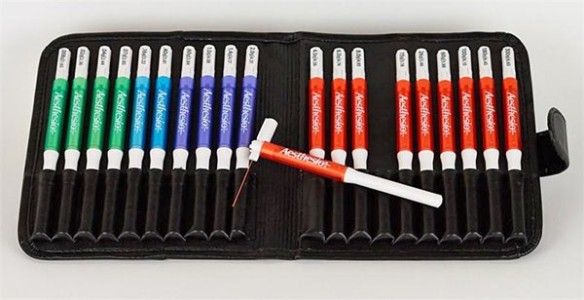
Von Frey Filaments (BIO-VF-M)
Source :