 Activity, Motor Control & Coordination
 Pain - Thermal Allodynia / Hyperalgesia
 Pain - Spontaneous Pain - Postural Deficit
 Pain - Mechanical Allodynia / Hyperalgesia
 Anxiety & Depression Disorder
 Learning/Memory - Attention - Addiction
 Physiology & Respiratory Research
 Metabolism & Nutrition
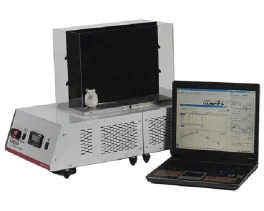
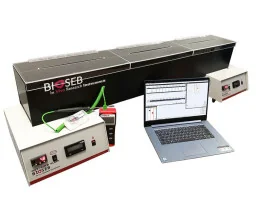
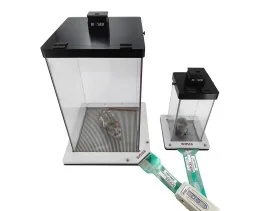
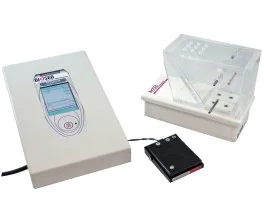
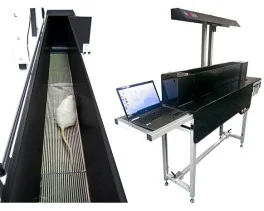
![Dynamic Weight Bearing 2.0 – Postural Module [Add-on]](https://bioseb.com/733-home_default/dynamic-weight-bearing-20-add-on-postural-module.jpg)





 Pain
Pain Central Nervous System (CNS)
 Neurodegeneration
 Sensory system
 Motor control
 Mood Disorders
 Other disorders
 Muscular system
 Joints
 Metabolism
 Cross-disciplinary subjects
 CONFERENCES & MEETINGS 2026
 Authors
Huzard, Damien, Oliva, Giulia, Marias, Mélanie, Granat, Chloé, Soubeyre, Vanessa, do Nascimento Pereira, Glaécia, Negm, Ahmed, Grellier, Gawain, Devaux, Jérôme, Bourinet, Emmanuel, François, Amaury
Lab
Journal
Translational Psychiatry
Abstract
Autism Spectrum Disorder (ASD) is a neurodevelopmental disorder marked by social deficits, repetitive behaviors and atypical sensory perception. The link between ASD and skin abnormalities, inducing itchiness, has never been investigated in depth. This study explores mechanical itch sensitivity in the Shank3ÃŽâ€C/ÃŽâ€C mouse model. Key observations include heightened scratching in response to skin deformation and hypersensitivity to mechanical itch (i.e. alloknesis) in Shank3ÃŽâ€C/ÃŽâ€C mice. In Shank3ÃŽâ€C/ÃŽâ€C mice, ex vivo electrophysiological experiments revealed that C-fiber low-threshold mechanoreceptors (C-LTMRs) were hyporesponsive and transcriptomic analysis showed a downregulation of TAFA4, a protein secreted by C-LMTRs. Interestingly, pharmacologically inhibiting Aβ-LTMR, important in mechanical itch initiation, abolished the itch hypersensitivity. Also, TAFA4 injections reduced the spontaneous scratching response to skin deformation but failed to restore itch sensitivity. Our data suggest that somatosensory deficits in Shank3ÃŽâ€C/ÃŽâ€C mice lead to a hypersensitivity to itchiness and indicate that two pathways might be regulating mechanical itchiness, dependent or not on TAFA4.
Keywords/Topics
Autism spectrum disorders; Molecular neuroscience
BIOSEB Instruments Used:
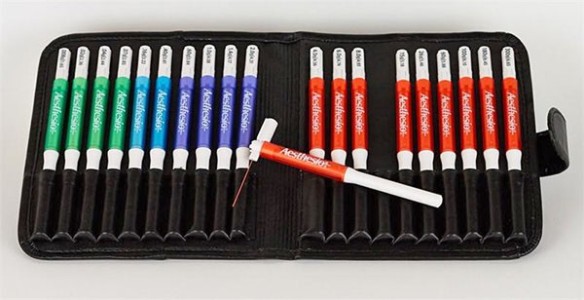
Von Frey Filaments (BIO-VF-M)
Source :