 Activity, Motor Control & Coordination
 Pain - Thermal Allodynia / Hyperalgesia
 Pain - Spontaneous Pain - Postural Deficit
 Pain - Mechanical Allodynia / Hyperalgesia
 Anxiety & Depression Disorder
 Learning/Memory - Attention - Addiction
 Physiology & Respiratory Research
 Metabolism & Nutrition

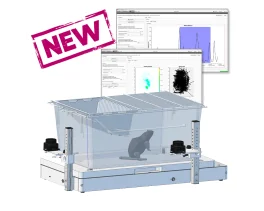



![Dynamic Weight Bearing 2.0 – Postural Module [Add-on]](https://bioseb.com/733-home_default/dynamic-weight-bearing-20-add-on-postural-module.jpg)












 Pain
Pain Central Nervous System (CNS)
 Neurodegeneration
 Sensory system
 Motor control
 Mood Disorders
 Other disorders
 Muscular system
 Joints
 Metabolism
 Cross-disciplinary subjects
 CONFERENCES & MEETINGS 2026
 Authors
Micah Johnson, Maureen Eberle, Ian Hultman, Xinyu Zhang, Yassine Filali, Benjamin Hing, Molly Matkovich, Alli Jimenez, Sara Mitchell, Anjayooluwa Adegboyo, Radha Velamuri, Julia Miller, Kung-Sik Chan, Sanvesh Srivastava, Rainbo Hultman
Lab
Journal
bioRxiv
Abstract
ABSTRACT
Background
Migraine is a disorder of severe, recurrent headaches and debilitating sensory, cognitive and affective symptoms, often triggered by stress. Early life stress in childhood has been shown to increase the likelihood of migraine in adulthood in humans. Calcitonin-gene relate peptide (CGRP) has been shown to reliably and acutely induce migraine or migraine-like behavior in both humans and rodent models. Here we investigate the impact of early life stress and CGRP on migraine-related neural circuitry, as well as the impact of early life stress on CGRP-mediated migraine-like activity in order to better understand the mechanisms by which early life stress predisposes neural circuitry to migraine brain activity.
Methods
We implemented an early life stress paradigm in the outbred strain of mice, CD1. We evaluated the impact of peripheral CGRP on migraine-like behavior and employed multi-site in vivo neurophysiology in freely behaving mice. A changepoint analysis was used to dissect differences in individual CGRP-induced responses.
Results
We found that early life stress exacerbated migraine-related behavioral and network physiology. CGRP alone caused disruptions in neural oscillatory activity across a network of brain regions including the anterior cingulate cortex (ACC), amygdala (AMY), thalamus (Po, VPM, and MDthal), and parabrachial nucleus (PBN). We found that power across the network was lowered within 10 minutes of peripheral CGRP exposure, which was sustained for 40-50 min. Coherence was mostly disrupted in amygdalar brain region pairings, and took on a shorter timecourse, with partial rescue of these responses by migraine abortive, sumatriptan. We found that early life stress exacerbated most of these responses, especially AMY-thalamic coherence pairings, although early life stress in the absence of CGRP demonstrated no impact on the network overall. We further identified individual mice with brain-network activity hypersusceptible to migraine.
Conclusions
Our findings demonstrate that early life stress confers vulnerability to migraine, simultaneously impacting behavior and brain network activity responses to peripheral CGRP.
Keywords/Topics
early;stress;induces;brain-wide;electrical;network;predisposition;migraine;abstract;background
BIOSEB Instruments Used:
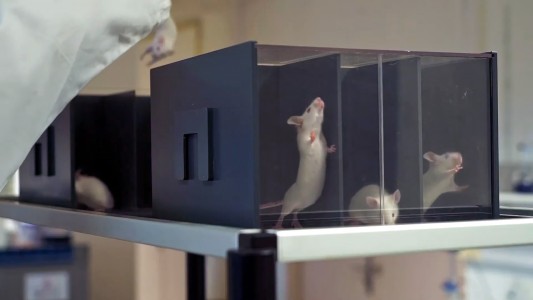
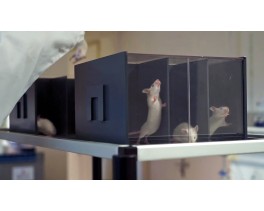
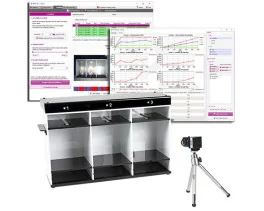
Modular holder cages for rats and mice (BIO-PVF)
Source :
https://www.biorxiv.org/content/10.1101/2024.11.14.622885.abstract